I’m a big fan of Yuval Harari’s expansive perspectives on the human condition and his book “Homo Deus” is a brilliant speculation of the future of our human species’ history. Of all the many gems of insight in his book, I found this commentary about the “greatest scientific discovery” of all time to be particularly apropos here:
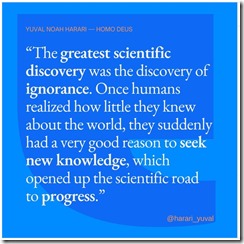
“For thousands of years the scientific road to growth was blocked because people believed that holy scriptures and ancient traditions already contained all the important knowledge the world had to offer. A corporation that believed all the oil fields in the world had already been discovered would not waste time and money searching for oil. Similarly, a human culture that believed it already knew everything worth knowing would not bother searching for new knowledge. This was the position of most premodern human civilisations. However, the Scientific Revolution freed humankind from this naïve conviction. The greatest scientific discovery was the discovery of ignorance. Once humans realised how little they knew about the world, they suddenly had a very good reason to seek new knowledge, which opened up the scientific road to progress.”
Knowing what you don’t know is the single most important knowledge you can have.
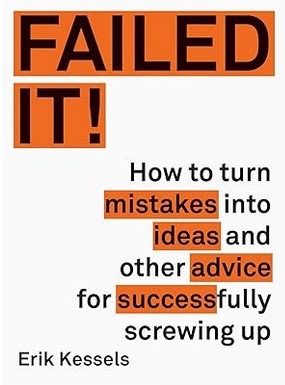
The book is sort of an all-star collection of failure quotes and observations. Many of the perspectives that I have shared in countless posts here, but distilled into terse and punchy presentation. Also, a big portion of the book is photography portraying different concepts which add to the ease and enjoyment of reading it. And it includes a bit of whimsical “failure” in its very layout.
Before the British celebrate their bonus national holiday next week in honour of the King’s Coronation, the Netherlands is celebrating its own Kings Day (It annual national holiday) today. An apropos occasion to showcase another country’s positive attitude to failure (in this case, the ultimate failure of fatality). This one I stumbled upon in the NBC article “Malaysia Flight 17: The Unique Way the Dutch Mourn”
“In the main the reaction to the sudden loss of a cross-section of Dutch society – the proportionate loss of life for a country the size of the United States would be about 6,000 people – has been muted…The Dutch are strikingly different from Americans in their gut reactions to things…The Dutch have an innate distrust of ideology…It has something to do with being a small country surrounded by larger countries that have had long histories of asserting themselves. It also stems from the fact that Dutch society grew not out of war against a human foe but out of the struggle against nature. Living in low lands on a vast river delta, the Dutch came together to battle water. Building dams and dikes and canals was more practical than ideological. For better or worse, the Dutch are more comfortable with meetings and remembrances than with calls to arms.”
Another gem from my top family contributor to the blog, our son Chase. He shared this video piece about embracing “bad music”. I certainly appreciate the value of injecting experimentation, serendipity, break from convention and even a bit of randomness and deliberate variation from the norm. But “Simon the Magpie” takes those principles to new levels. He introduces the video with the following:
· “Are you someone who’s always wanted to make music but feels discouraged because you don’t think you’re very good at it? Well, you’re not alone, and in this video, we’ll explore the surprising benefits of being bad at making music.”
“Firstly, when you’re bad at making music, you’re more likely to experiment and try new things. You won’t be weighed down by the pressure to create something perfect, which means you’ll be more open to taking risks and exploring new ideas. This can lead to unique and innovative sounds that you might not have discovered otherwise.”
“Secondly, being bad at making music allows you to embrace imperfection. It’s okay to make mistakes, and in fact, some of the greatest musicians of all time have made mistakes and embraced them as part of their sound. By accepting your flaws, you can focus on the parts of your music that make it unique and special.”
“Thirdly, making bad music can be a great stress reliever. It’s not about creating something perfect, but rather about having fun and enjoying the process. This can help you let go of stress and anxiety and focus on the present moment.”
“And finally, being bad at making music can actually help you improve. By making mistakes and experimenting, you’ll learn what works and what doesn’t. This will help you refine your skills and ultimately create better music.”
The message dovetails with a post by my all-time top contributor, Hugh MacLeod, “What’s Your Latest Bad Idea?“ I especially like his accompanying cartoon illustrating the convoluted path through bad ideas to a good one. It is important to point out that embracing “failure” is the *means*, not the *ends*. We don’t seek out failure for its own sake (that would make life very easy). Instead, we use failure as. But like a hammer or scaffolding, we put it away when we are done with our project.
As Thomas Edison said, "The key to having great ideas is having a lot of bad ones first." The problem is not having the bad ideas…it is in recognizing the good ones hidden among them. Especially important with the digital age of ChatGPT which will be a nuclear reactor of idea generation, but as has been well documented, very may of these4 are quite bad. But as a tool for mining ore, it could be a gold mine for those effective at refining its output. I experienced tis directly just this week when I needed to draft a fairly routine business correspondence and we decided to try OpenAI on the task. Frankly, the system produced a better first draft than I think I would have done. BUT, there were several very subtle bits which were really quite off (didn’t flow, didn’t make sense), but were readily fixed by a quick edit by me. Perhaps the Age of AI will make us all editors. So practice now by coming up with as many bad ideas and as much bad music as possible to practice on.
Happy (?) Boring Day today. Well, at least I hope you have some periods of boredom to “enjoy” And if you are wondering what could be enjoyable about boredom, have a listen to “Why Boredom is Good for You” by one of my subscribed YouTube channels, Veritasium, Derek Muller goes through a number of studies that show boredom has some very positive dividends if you embrace it:
Creativity – “When you are bored, your mind wanders…studies have shown that this wandering is good for creativity.”
Reassessment – “Boredom is both a warning that we are not doing what we want to be doing. And push that motivates us to switch goals and projects.”
Generosity – “Studies also show that boredom stimulates altruism…Studies show that more bored participants are more likely to give blood or give to charity.”
Goal Setting – “When given tasks that only use a part of their mental capacity, study participants often thought of the future and their plans for it. In this way, being bored is essential for goal setting.”
“The fool doth think he is wise, but the wise man knows himself to be a fool.” – Twelfth Night, William Shakespeare
April Fools! A celebration of failing to be serious which has some serious benefits. In particular, speaking the uncomfortable truth (softened with whimsy and humour) to power (or to any of us really). Hugh McLeod underscored (and illustrated – see above) this concept in his post “Should We Bring Back the Jester?”:
“I’m Belgium based and want to start a movement around re-installing the jester and creating a jester culture (open and inclusive feedback and creating a safe space). This is not rocket science to be honest, but maybe the C-Suite needs some external support. Not coaching, but a real jester holding the mirror and giving candid but respectful and human insight on blind spots, perceptions, and impact that leaders have on the organisation.”
“Sometimes dreams aren’t meant to be.” – Tim Jandreau
Biopics have long been a popular film genre, but “The Rider” is the first auto-biopics I’ve ever seen. All of the main characters are “actors” playing themselves in the story of their own lives. An incredibly moving story of the death of dreams in its own right, but when you realise that (a) this story actually happened, and (b) it actually happened to these people, it sends the authenticity-o-meter off the scale.
“The Rider” depicts one of the critical aspects to the death of dreams – acceptance. The protagonist, Brady Jandreau (aka Brady Blackburn IRL), is never being quixotic about his dreams. From the outset, he understands the impact of his injury, he respects the hazards and limitations it imposes on this life, and he accepts the context of responsibilities in which he must pursue any dream. The film is an odyssey from trauma to acceptance played out in a truly intimate grieving process.
Today is the anniversary of the Reichstag Fire Decree which is historically to the loss of liberty what the Magna Carta was to the spread of freedoms. It rescinded most civil liberties, including rights of assembly and freedom of the press, and allowed the police to detain people indefinitely without charges. It was like an anti-Constitution. While the Magna Carta was over 800 years ago, the decree was 90 years ago today. Freedom does not go in one direction on the timeline of humanity.
· “The enemies of liberal democracy, they have a method. They hack our feelings. Not our emails, not our bank accounts — they hack our feelings of fear and hate and vanity, and then use these feelings to polarize and destroy democracy from within. This is actually a method that Silicon Valley pioneered in order to sell us products. But now, the enemies of democracy are using this very method to sell us fear and hate and vanity. They cannot create these feelings out of nothing. So they get to know our own preexisting weaknesses. And then use them against us. And it is therefore the responsibility of all of us to get to know our weaknesses and make sure that they do not become a weapon in the hands of the enemies of democracy. Getting to know our own weaknesses will also help us to avoid the trap of the fascist mirror. As we explained earlier, fascism exploits our vanity. It makes us see ourselves as far more beautiful than we really are. This is the seduction. But if you really know yourself, you will not fall for this kind of flattery. If somebody puts a mirror in front of your eyes that hides all your ugly bits and makes you see yourself as far more beautiful and far more important than you really are, just break that mirror.”
“Until we have met the monsters in ourselves, we keep trying to slay them in the outer world. And we find that we cannot. For all darkness in the world stems from darkness in the heart. And it is there that we must do our work.” – Marianne Williamson
Happy Halloween! A festival of embracing the horrific and terrifying in life.
I love all these tips for life by Founding Editor of Wired Magazine Kevin Kelly, “103 Bit of Advice I Wish I Had Known,” but was especially struck by how many (25) echo the theme of embracing failure to various degrees (thanks Steve). Having passed a senior milestone birthday myself last year, I have an intensified appreciation for the insights of a life well lived (and not so well at times)
Dont keep making the same mistakes; try to make new mistakes.
When you forgive others, they may not notice, but you will heal. Forgiveness is not something we do for others; it is a gift to ourselves.
Three things you need: The ability to not give up something till it works, the ability to give up something that does not work, and the trust in other people to help you distinguish between the two.
Ask anyone you admire: Their lucky breaks happened on a detour from their main goal. So embrace detours. Life is not a straight line for anyone.
The best way to get a correct answer on the internet is to post an obviously wrong answer and wait for someone to correct you.
Don’t wait for the storm to pass; dance in the rain.
Half the skill of being educated is learning what you can ignore.
The advantage of a ridiculously ambitious goal is that it sets the bar very high so even in failure it may be a success measured by the ordinary.
A great way to understand yourself is to seriously reflect on everything you find irritating in others.
90% of everything is crap. If you think you don’t like opera, romance novels, TikTok, country music, vegan food, NFTs, keep trying to see if you can find the 10% that is not crap.
You will be judged on how well you treat those who can do nothing for you.
We tend to overestimate what we can do in a day, and underestimate what we can achieve in a decade. Miraculous things can be accomplished if you give it ten years. A long game will compound small gains to overcome even big mistakes.
Thank a teacher who changed your life.
Your best job will be one that you were unqualified for because it stretches you. In fact only apply to jobs you are unqualified for.
It’s thrilling to be extremely polite to rude strangers.
Getting cheated occasionally is the small price for trusting the best of everyone, because when you trust the best in others, they generally treat you best.
Prescription for popular success: do something strange. Make a habit of your weird.
Dont believe everything you think you believe.
Actual great opportunities do not have “Great Opportunities” in the subject line.
Dont bother fighting the old; just build the new.
Your time and space are limited. Remove, give away, throw out things in your life that dont spark joy any longer in order to make room for those that do.
For a great payoff be especially curious about the things you are not interested in.
Every breakthrough is at first laughable and ridiculous. In fact if it did not start out laughable and ridiculous, it is not a breakthrough.
Rather than steering your life to avoid surprises, aim directly for them.
Aim to die broke. Give to your beneficiaries before you die; it’s more fun and useful. Spend it all. Your last check should go to the funeral home and it should bounce.


 Leadership and Management / Turning Adversity to Advantage